
合気道
The Way of Harmonizing Energy — a modern Japanese martial art of blending, redirection, and control.
What is Aikido
Aikido is a Japanese martial art founded by Morihei Ueshiba (1883–1969), known to practitioners as Ō-Sensei, “Great Teacher.” Drawing on his mastery of Daitō-ryū Aiki-jūjutsu, sword, and spear, he refined those older combat systems into a discipline whose goal is to neutralize an attack without meeting force with force.
The name combines three characters: ai (合, harmony or joining), ki (気, energy or spirit), and dō (道, way or path) — “the way of harmonizing with energy.”
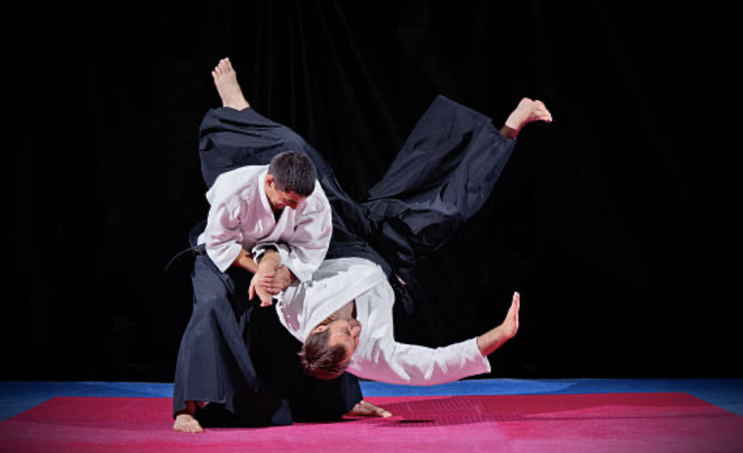
In practice, Aikido consists mainly of throws (nage-waza) and joint-control pinning techniques (katame-waza) applied to the wrist, elbow, and shoulder. Training is done in pairs: uke attacks and receives the technique, nage (or tori) applies it, and the roles alternate. Learning to fall safely — ukemi — is a core skill from the first day.
Aikido Philosophy
Aikido’s central idea is that conflict is best resolved by joining with an attack rather than opposing it. Rather than block and counter, the defender enters, turns, and leads the attacker’s momentum until it is spent — leaving the attacker unbalanced and controlled.
Ueshiba framed this as more than tactics. He taught that true victory is masakatsu agatsu — “true victory is victory over oneself” — and that the purpose of the art is to protect all beings, including the attacker. This is why Aikido techniques are designed to control and redirect rather than to injure, and why the art is often described as a martial art of reconciliation.
“To injure an opponent is to injure yourself. To control aggression without inflicting injury is the Art of Peace.”
Main Principles
Blending — Awase
Match the attacker’s timing, direction, and speed instead of colliding with them. Force meeting force is a contest of strength; blending removes the contest.
Entering — Irimi
Move decisively into the attack, off its line, rather than retreating. Closing distance at the right angle takes away the attacker’s power and options.
Turning — Tenkan
Pivot around a stable center to redirect incoming force into a circle. The attacker’s own momentum carries them past you and off balance.
Center & Posture — Hara / Shisei
Movement originates from the lower abdomen and whole body, not the arms. Upright, relaxed posture keeps balance available at every moment.
Breaking Balance — Kuzushi
A technique works because the attacker’s balance is already taken. With kuzushi, the throw needs little strength; without it, no amount is enough.
Distance & Timing — Ma-ai
The correct interval in space and time between partners. Right technique at the wrong distance or moment fails; correct ma-ai makes it inevitable.
Extension — Ki no nagare
Relaxed, connected, outward-flowing energy rather than muscular tension. Power comes from connection and structure, not from gripping and pulling.
Awareness — Zanshin
Sustained attention before, during, and after the technique. Engagement is not over when the attacker lands; readiness and connection remain.
Receiving — Ukemi
The art of falling and being thrown safely. It protects the body, teaches how techniques actually work, and makes hard practice sustainable.
Videos
Practice and demonstration recordings. Click the title to play in a new tab, or the round download button beside it to save the file.